Heat Pump Defrost Cycles in Bristol's Damp Winters
Last reviewed: 2 October 2026
Bristol rarely gets hard frosts, yet heat pumps here defrost regularly. That's because damp air just above freezing is what ices a heat pump's coil. Here's what happens, what it costs, and when to call an engineer.
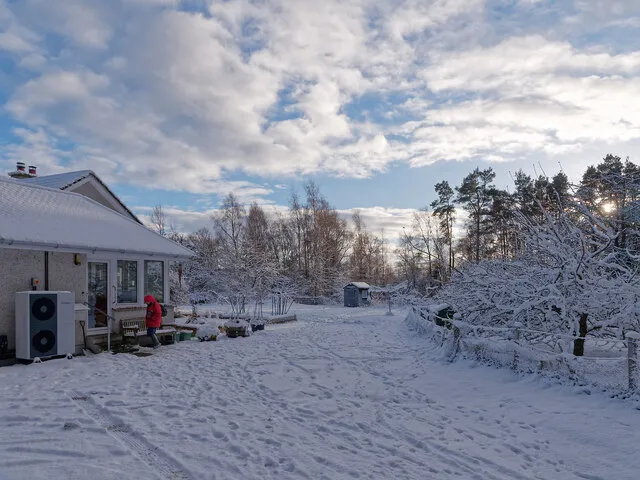
Damp, not just cold
You might expect a heat pump to defrost most on the coldest nights. In fact, frost builds up fastest when the air is damp and hovering just above or around freezing — roughly 0°C to 6°C with high humidity. That describes a great many Bristol winter days.
Bristol is mild — Filton averages a January overnight low of about 2.4°C and only around 33 air-frost days a year — but it’s also wet, with roughly 820 mm of rain a year and plenty of mist off the Severn and the Avon. So Bristol heat pumps tend to defrost fairly often, even in winters with few hard frosts.
Why frost forms on the coil
To collect heat from the air, the outdoor coil has to be colder than the air passing over it, often several degrees below freezing. Moisture in the air condenses on the cold fins and freezes, just as frost forms on a car windscreen. A thin layer is harmless, but if it builds up it blocks the airflow and the heat pump collects less heat.
What a defrost cycle does
When the controller detects frost — from temperature sensors or falling performance — it briefly reverses the refrigerant cycle. Warm refrigerant flows to the outdoor coil instead of to your heating, melting the ice in a few minutes. Then normal heating resumes.
During a defrost you might notice:
- the fan stopping
- a puff of steam rising from the unit
- water dripping or running from underneath
- a soft whoosh as the refrigerant changes direction
All of this is normal.
Does it make the house cold?
No. A defrost takes a few minutes, and your home holds plenty of heat in that time. Well-designed systems use some of the warmth in the heating water to power the defrost, so radiators may cool very slightly but rooms won’t notice.
How much energy does it use?
A little. Defrosting is part of the reason a heat pump’s efficiency dips in damp, cool weather, and it’s already allowed for in realistic seasonal efficiency figures. In Bristol’s climate, a well-designed system still averages around 3.2–3.8 units of heat per unit of electricity over the year.
Siting and drainage in Bristol gardens
The meltwater has to go somewhere. Each defrost can release a litre or more. Good installation:
- raises the unit on feet or a bracket so ice can’t build up underneath
- directs water to gravel, a soakaway or a drain, not across a path or steps
- avoids spots where water would run down a steep garden onto a neighbour’s patio, a real consideration on Bristol’s hillside terraces in Totterdown, Windmill Hill and Clifton Wood
- keeps the unit clear of overhanging gutters that would drip onto it
When to call an engineer
- Ice covering most of the coil that doesn’t clear after a defrost
- Defrosts happening every few minutes for hours
- A thick block of ice building up underneath the unit
- The fan not turning when the unit should be running
These usually point to a faulty sensor, a fan problem, low refrigerant or poor drainage. Switch the unit off at the isolator and don’t chip at the ice — the fins are delicate. See heat pump repair.
Related reading
See what a heat pump would look like in your Bristol home
The mechanism is the same in every UK home; the design is specific to yours. Our team carries out a free in-home survey including a full room-by-room heat-loss calculation, identifies the system size and configuration that fits your property, and provides a written quote with the £7,500 BUS grant already deducted.
You'll see the actual figure you'd pay — not an estimate — and the projected efficiency for your specific install.